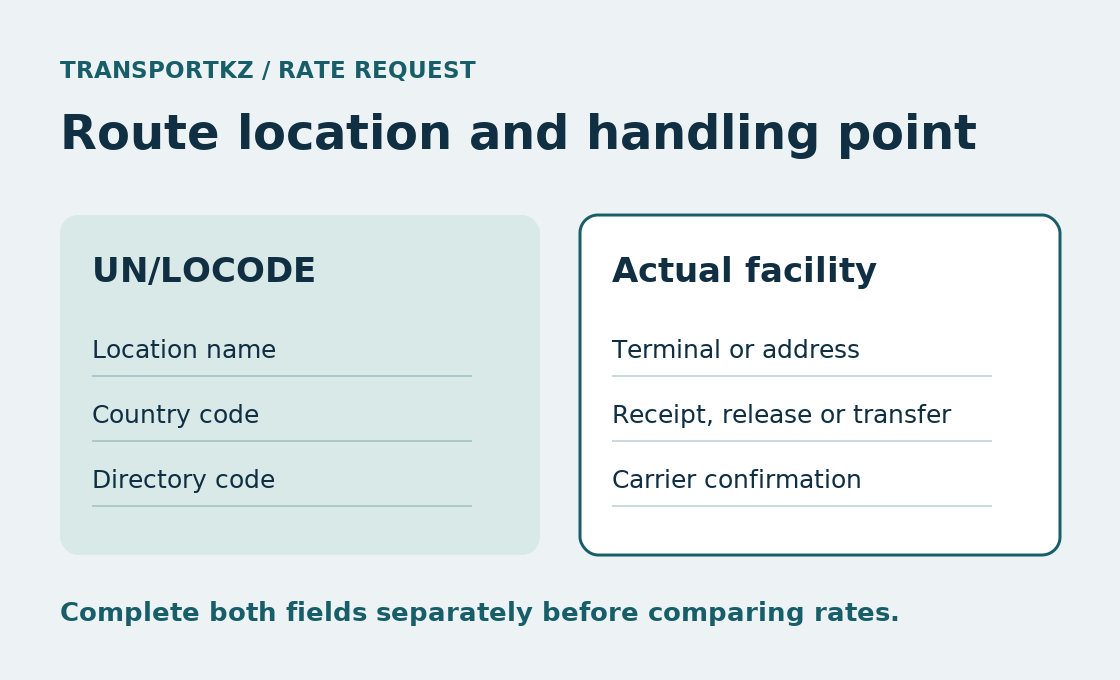
Check the route location entry
In the UN/CEFACT vocabulary, UN/LOCODE identifies an administrative or economic area significant to international trade and transport. The entry gives the associated ISO 3166-1 country code. Kazakhstan is listed as KZ in the country directory.
Check the location name, country and code in the official list. If the correspondence gives only the name of a city or a wider area, do not guess the code. Leave it for confirmation and note which operation the location is needed for.
How a function differs from an address
In the function classification, 1 denotes maritime transport and 2 denotes rail transport. In its explanation of the railway function, UN/CEFACT specifically notes that individual terminals within one location are not treated as separate locations.
Keep the location code and terminal in separate fields when requesting a quote. Ask the carrier to confirm the terminal’s exact name, its address or gate, and the operation: acceptance, release or transshipment. Do not infer from the location code that a service is available, that the cargo is ready or that a time has been agreed.
Use one template for all quotes
Fill in one row for each location. Include the location’s role, official name, country, UN/LOCODE, terminal or address, operation and confirmation status. Note where and when you checked the code. If a field is unconfirmed, leave it blank and ask one specific question.
When a quote comes in, compare the areas and the actual handling locations separately. If two replies give the same code but different terminals, ask which location the quoted price covers. This is an editorial template for checking a route. Confirm tariffs and schedules separately.
Before comparing quotes, check two things: the directory and the request identify the same location, and the carrier has confirmed the exact place and operation within it.